Official Logo of Columbia Business School
Academics
  • Visit Academics
  • Degree Programs
  • Admissions
  • Tuition & Financial Aid
  • Campus Life
  • Career Management
Faculty & Research
  • Visit Faculty & Research
  • Academic Divisions
  • Search the Directory
  • Research
  • Faculty Resources
  • Teaching Excellence
Executive Education
  • Visit Executive Education
  • For Organizations
  • For Individuals
  • Program Finder
  • Online Programs
  • Certificates
About Us
  • Visit About Us
  • CBS Directory
  • Events Calendar
  • Leadership
  • Our History
  • The CBS Experience
  • Newsroom
Alumni
  • Visit Alumni
  • Update Your Information
  • Lifetime Network
  • Alumni Benefits
  • Alumni Career Management
  • Women's Circle
  • Alumni Clubs
Insights
  • Visit Insights
  • Digital Future
  • Climate
  • Business & Society
  • Entrepreneurship
  • 21st Century Finance
  • Magazine
CBS AI Landing Image
AI@CBS
  • Latest on AI
  • Faculty Perspectives
    • All Perspectives
  • In the Classroom
    • AI Courses at CBS
  • Careers
  • Events
  • AI Research
  • In the News
  • More 

AI@CBS

Leading through intelligence—both human and artificial—at Columbia Business School.

Jump to main content

Committed to the Future of Artificial Intelligence

Through cutting-edge curricular innovation, our MBA, Executive MBA, MS, and PhD programs introduce new courses and research that seamlessly integrate AI into the student experience. From exploring the impact of AI across industries to developing hands-on experience with the latest tools, students can build confidence in using the latest tech in their chosen fields.

AI plays a critical role in the rapidly evolving modern workplace, and with a curriculum that emphasizes its societal and business implications, students can fully prepare to lead in this rapidly evolving landscape. Explore how our students, faculty, centers and programs are engaging with AI at Columbia Business School.

AI at Columbia Business School logo in blue lowercase letters with a plus above the i.

Latest on AI@CBS

Algorithms, Analytics, Artificial Intelligence, Business and Society, Business Economics and Public Policy, Data and Business Analytics, AI and Transformative Tech, Digital IQ, Finance, Marketing, Marketplace
Date
April 17, 2025
Close-up computer monitor with trading software
Algorithms, Analytics, Artificial Intelligence, Business and Society, Business Economics and Public Policy, Data and Business Analytics, AI and Transformative Tech, Digital IQ, Finance, Marketing, Marketplace

Designing Smarter Economic Systems: A New Approach to Mechanism Design

Award-winning research from Professor Laura Doval tackles the “limited commitment” problem in economics, offering a model that helps governments and firms adjust rules and strategies based on new information over time.
  • Read more about Designing Smarter Economic Systems: A New Approach to Mechanism Design about Designing Smarter Economic Systems: A New Approach to Mechanism Design
Artificial Intelligence, Business and Society, Climate and Policy, Climate and Solutions, Climate and Technology, Future of Work, Leadership
Date
April 11, 2025
McKinsey’s Eric Kutcher
Artificial Intelligence, Business and Society, Climate and Policy, Climate and Solutions, Climate and Technology, Future of Work, Leadership

McKinsey’s Eric Kutcher on AI, Management Strategy, and Climate Innovation

During a recent Distinguished Speakers Series event, the Senior Partner and Chair of North America at McKinsey shared leadership insights on AI business strategy, climate innovation, and the future of work.
  • Read more about McKinsey’s Eric Kutcher on AI, Management Strategy, and Climate Innovation about McKinsey’s Eric Kutcher on AI, Management Strategy, and Climate Innovation
Artificial Intelligence, Data and Business Analytics, Data/Big Data, AI and Transformative Tech, Digital IQ, Marketing, Technology
Date
April 08, 2025
A woman shopping in a grocery store
Artificial Intelligence, Data and Business Analytics, Data/Big Data, AI and Transformative Tech, Digital IQ, Marketing, Technology

How Gen AI Is Transforming Market Research

The technology provides faster, cheaper, and scalable ways to gather data and generate insights. In this article, Professor Olivier Toubia and his co-researchers offer a guide to the most promising opportunities.
  • Read more about How Gen AI Is Transforming Market Research about How Gen AI Is Transforming Market Research
Artificial Intelligence, Business and Society, Leadership, Organizations, The Workplace
Date
March 21, 2025
Walmart Chief People Officer Donna Morris, left, with Professor Stephan Meier
Artificial Intelligence, Business and Society, Leadership, Organizations, The Workplace

Walmart’s Donna Morris on Building High-Performing Teams in the Age of AI

During a conversation hosted by Columbia Business School’s Distinguished Speaker Series, the multinational retailer’s Chief People Officer shared how leaders can use AI and people-first strategies to drive workplace innovation and resilience.
  • Read more about Walmart’s Donna Morris on Building High-Performing Teams in the Age of AI about Walmart’s Donna Morris on Building High-Performing Teams in the Age of AI
Explore More AI Insights
Faculty Perspectives on AI
Faculty Perspectives on AI Divider Image
Photo Image of Stephan Meier

Using AI to Enhance Human Motivation

Columbia Business School Professor Stephan Meier explains how leaders can calm AI-related concerns, while also creating value.

Quick Takes

  • AI can boost productivity and work-life balance through efficiency, but presents an equality paradox - potentially leveling the playing field or concentrating benefits among few while reducing overall jobs.
  • Future leaders (today's students) will determine AI's ultimate societal impact, making their understanding of these technologies crucial.
Watch the Video
Photo Image of Olivier Toubia

How to Leverage AI in the Workplace

Columbia Business School Professor Olivier Toubia shares the many upsides – and downsides – of AI in the workplace.

Quick Takes

  • Generative AI has dual potential - it can increase productivity and improve work-life balance while leveling the playing field, but could also increase inequality by limiting jobs to a select few and reducing overall opportunities.
  • The ultimate impact of AI on society and business will be determined by future leaders, making it critical for today's students to understand AI as they will shape its societal effects.
Watch the Video
Photo Image of Ashli Carter

Using Generative AI to Change Your Mindset

Ashli Carter, a lecturer at Columbia Business School, explains one of the ways she uses AI to help students build resilience.

Quick Takes

  • AI text-to-image generation helps people visualize their "inner critic" as a tool for negotiating with their mindset.
  • AI visualization processes can create mental states more conducive to achieving personal goals.
Watch the Video
Photo Image of Omar Besbes

How AI is Breaking Barriers in Business

Columbia Business School Professor Omar Besbes explains how AI is democratizing workplace productivity.

Quick Takes

  • AI will significantly enhance human productivity across various areas while potentially decreasing barriers to entry in multiple industries.
  • Chatbots and AI systems are democratizing access to resources while simultaneously putting the art of asking good questions and follow-up questions back at center stage.
Watch the Video
View More Faculty Perspectives on AI
AI@CBS In The Classroom
AI@CBS In The Classroom Divider Image
CBS Logo Icon Image

AI Tools

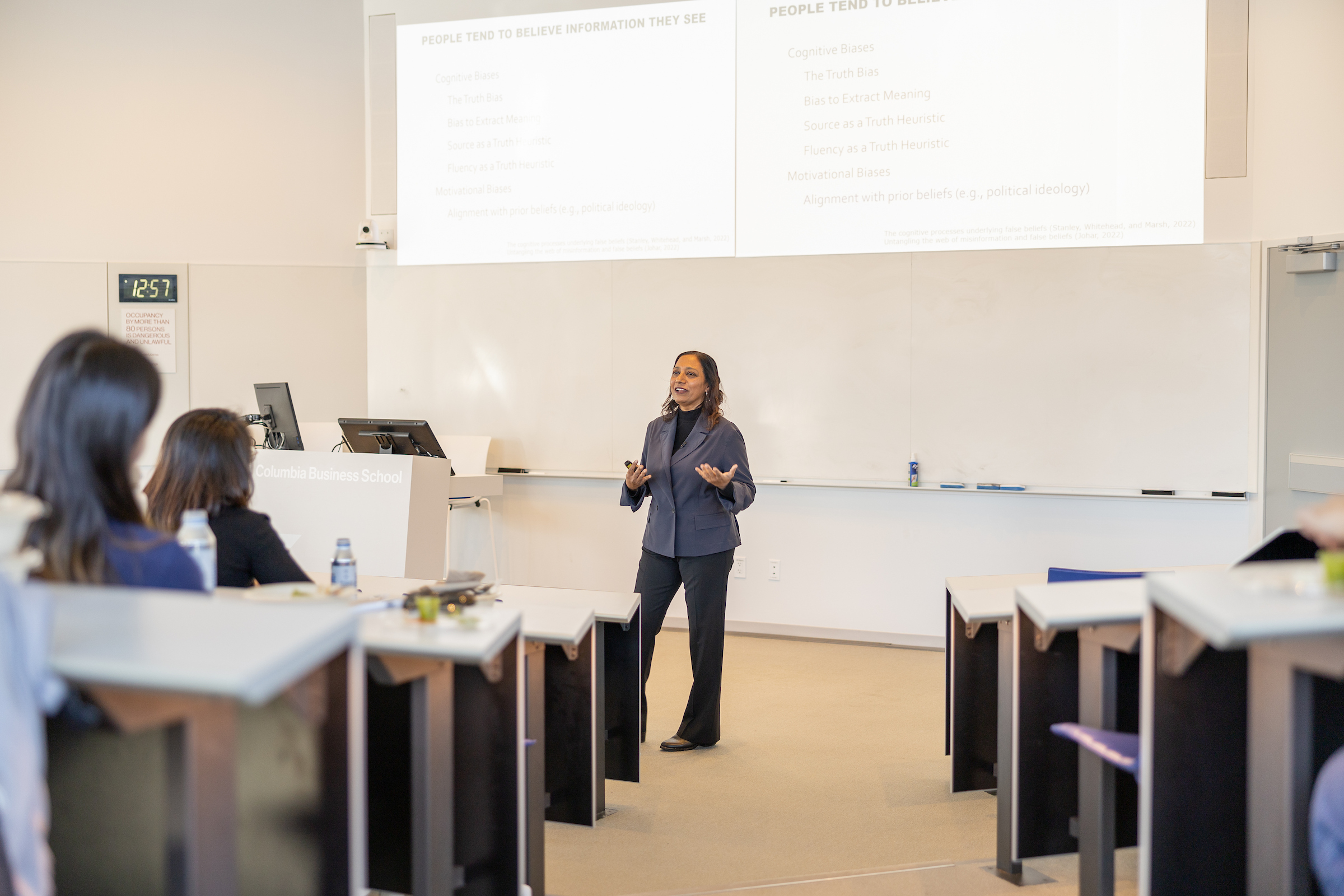
AI is integrated into our courses in ways that support student’s projects and inspire rich class discussions. Tools like ChatGPT are used to assist in breaking down complex research techniques, run business simulations, visualize data in real time, and to show students to think in new ways and explore innovative solutions.

View Available AI Tools at CBS
AI Icon Image

Courses

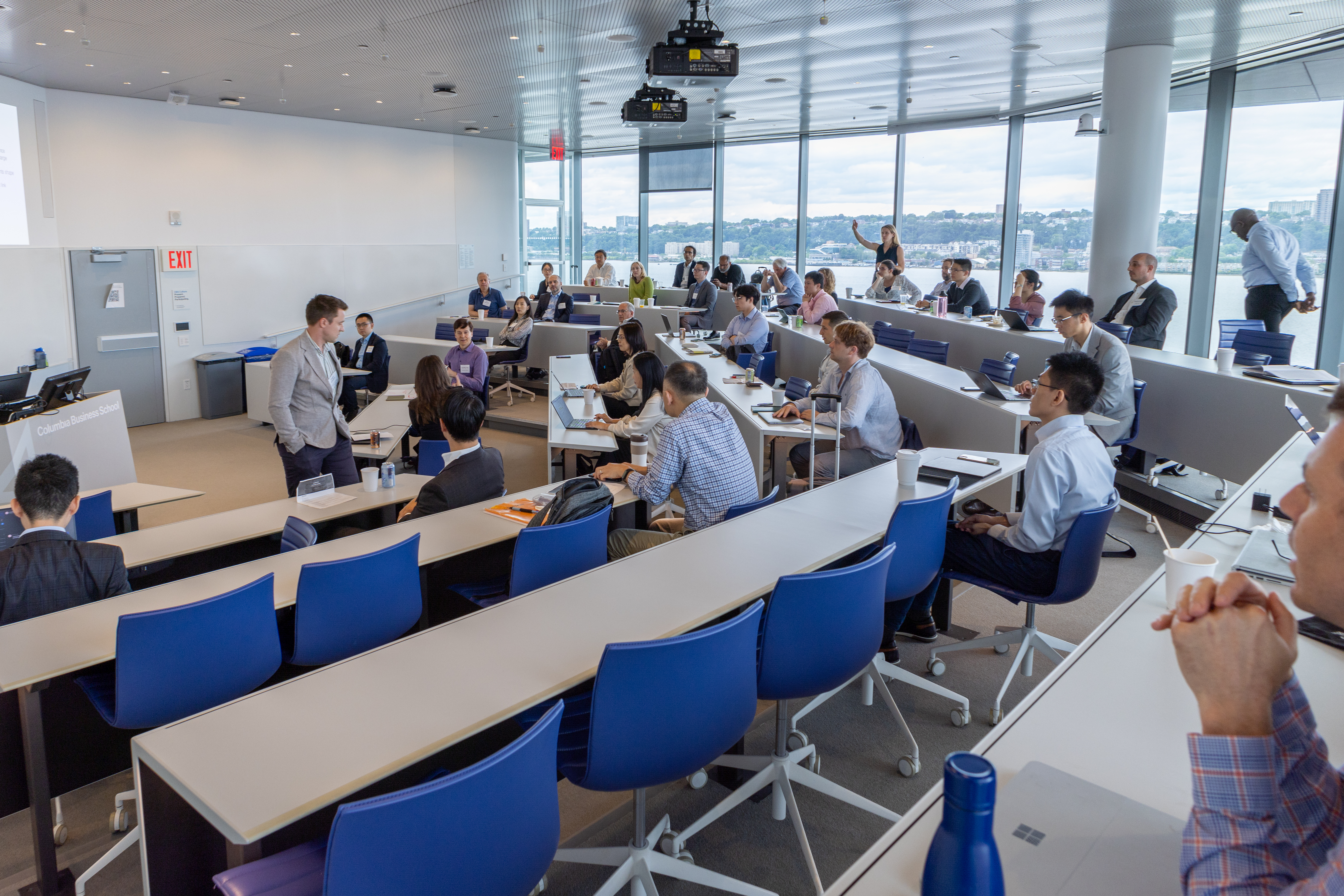
At Columbia Business School, we introduce you to the methods and tools that organizations around the world use to leverage data and artificial intelligence. You will learn how these techniques work, and how to use them. The curriculum spans everything from basic data analysis to generative AI, and contains classes suitable for all skill levels.

View Current AI Courses
Logo Icon Image

Resources

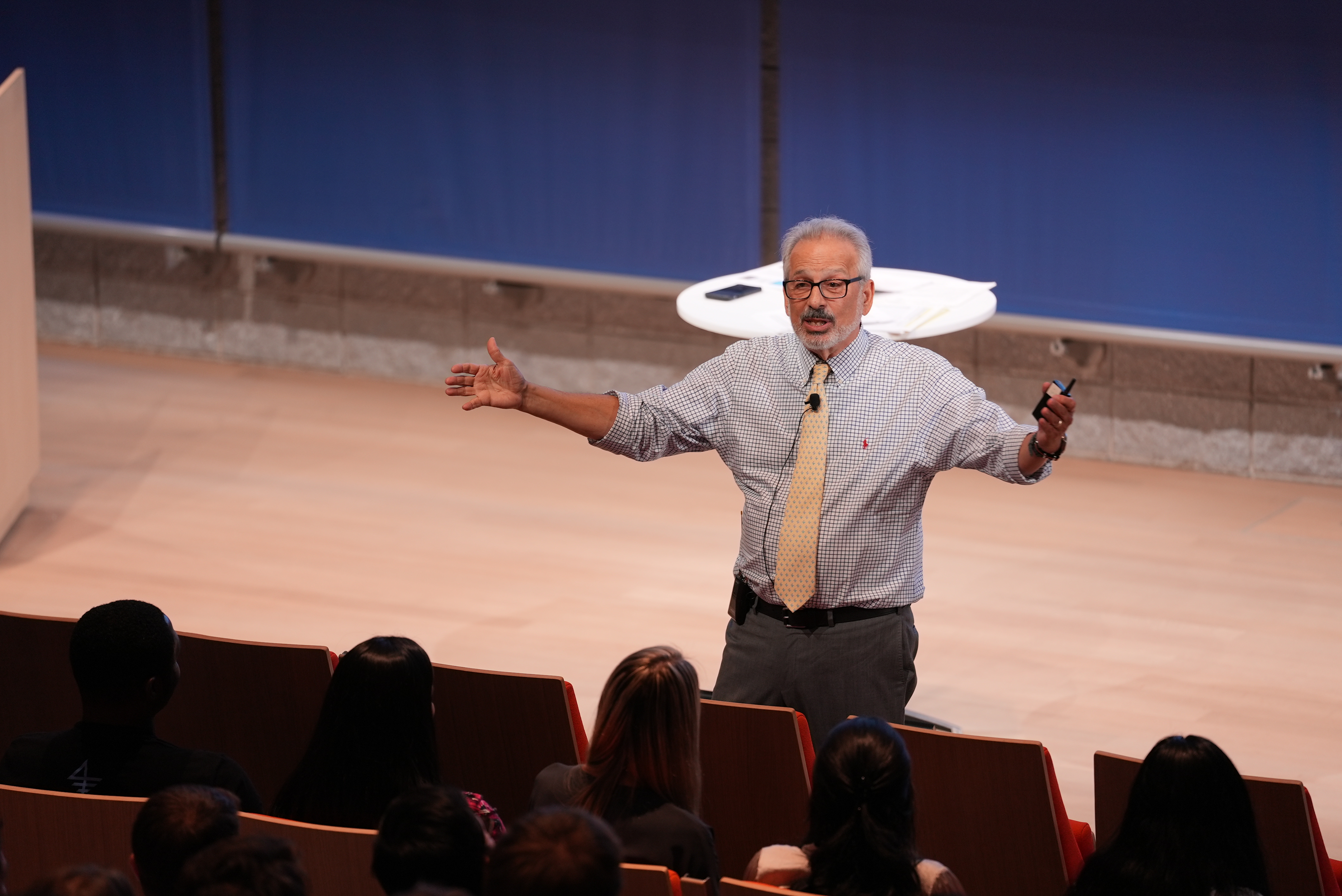
Generative artificial intelligence (AI) is reshaping industries worldwide, and higher education is no exception. Much like other transformative innovations before it, AI-powered language models have introduced new opportunities and challenges, changing the way students learn and how instructors teach.

Samberg Institute

At Columbia Business School, the Arthur J. Samberg Institute for Teaching Excellence serves as a guiding force in this ongoing transformation, equipping faculty with the knowledge, tools, and strategies they need to leverage generative AI for effective teaching.

View their website

Digital Future Initiative

The Digital Future Initiative focuses Columbia Business School’s world-class research and teaching on how technology is altering all industries and the fabric of daily life.

View their website

CBS Photo Image

Career Strategy

AI is changing the way we work, and the Career Management Center (Careers) at Columbia Business School has organized numerous AI-focused events and introduced AI-powered tools to help students and alumni adapt to these changes and achieve their long-term professional goals.

View AI@CBS Careers

Upcoming AI Events

See More AI Events
Faculty and AI Research
CBS Photo Image

AI@CBS Faculty

Dan Wang

Dan Wang

Lambert Family Professor of Social Enterprise in the Faculty of Business
Management Division
Co-Director of the Tamer Institute for Social Enterprise and Climate Change
Tamer Institute for Social Enterprise and Climate Change
Gita Johar

Gita Johar

Meyer Feldberg Professor of Business
Marketing Division
Daniel Guetta

Daniel Guetta

Associate Professor of Professional Practice
Decision, Risk, and Operations Division
Director
Center for Pricing and Revenue Management and Business Analytics Initiative
Photo of Professor Carri Chan

Carri Chan

John A. Howard Professor of Business
Decision, Risk, and Operations Division
Faculty Director Healthcare and Pharmaceutical Management Program
Healthcare and Pharmaceutical Management Program
Oded Netzer

Oded Netzer

Arthur J. Samberg Professor of Business
Marketing Division
Vice Dean for Research
Dean's Office
A. Carter

Ashli Carter

Lecturer in the Discipline of Management in the Faculty of Business
Management Division
Omar Besbes

Omar Besbes

Vikram S. Pandit Professor of Business
Decision, Risk, and Operations Division

Latest AI Research

The Best of Many Worlds: Dual Mirror Descent for Online Allocation Problems

Authors
Santiago Balseiro, Haihao Lu, and Vahab Mirrokni
Date
November 5, 2021
Format
Working Paper

Online allocation problems with resource constraints are central problems in revenue management and online advertising. In these problems, requests arrive sequentially during a finite horizon and, for each request, a decision maker needs to choose an action that consumes a certain amount of resources and generates reward. The objective is to maximize cumulative rewards subject to a constraint on the total consumption of resources.

Read More about The Best of Many Worlds: Dual Mirror Descent for Online Allocation Problems

Monopoly without a Monopolist: An Economic Analysis of the Bitcoin Payment System

Authors
Gur Huberman, Jacob D. Leshno, and Ciamac Moallemi
Date
November 1, 2021
Format
Journal Article
Journal
Review of Economic Studies

Bitcoin provides its users with transaction-processing services which are similar to those of traditional payment systems. This article models the novel economic structure implied by Bitcoin’s innovative decentralized design, which allows the payment system to be reliably operated by unrelated parties called miners. We find that this decentralized design protects users from monopoly pricing. Competition among service providers within the platform and free entry imply no entity can profitably affect the level of fees paid by users.

Read More about Monopoly without a Monopolist: An Economic Analysis of the Bitcoin Payment System

Queueing dynamics and state space collapse in fragmented limit order book markets

Authors
Costis Maglaras, Ciamac Moallemi, and Hua Zheng
Date
July 1, 2021
Format
Journal Article
Journal
Operations Research

In modern equity markets, participants have a choice of many exchanges at which to trade. Exchanges typically operate as electronic limit order books under a "price-time" priority rule and, in turn, can be modeled as multi-class FIFO queueing systems. A market with multiple exchanges can be thought of as a decentralized, parallel queueing system. Heterogeneous traders that submit limit orders select the exchange, i.e., the queue, in which to place their orders by trading off financial considerations against anticipated delays until their orders may fill.

Read More about Queueing dynamics and state space collapse in fragmented limit order book markets

A Personal Perspective on the Future of Discretionary Asset Management

Authors
Michael Weinberg
Date
June 28, 2021
Format
Newspaper/Magazine Article
Publication
AIMA Journal

If you were to ask a discretionary investment fund manager to draw a Venn diagram of the set notation where digitalization meets discretionary investing, many would not show the sets as overlapping. Moreover, they believe that the investment world is bifurcated and the discretionary managers are independent of the quantitative. I would argue that not only are the two sets converging but that the quantitative managers pose an existential threat to the discretionary managers, or perhaps will ‘Pac-Man’-style consume the discretionary managers.

Read More about A Personal Perspective on the Future of Discretionary Asset Management

How Quantifying the Shape of Stories Predicts Their Success

Authors
Olivier Toubia, Jonah Berger, and Jehoshua Eliashberg
Date
January 1, 2021
Format
Journal Article
Journal
Journal of Marketing Research

Narratives, and other forms of discourse, are powerful vehicles for informing, entertaining, and making sense of the world. But while everyday language often describes discourse as moving quickly or slowly, covering a lot of ground, or going in circles, little work has actually quantified such movements or examined whether they are beneficial.

Read More about How Quantifying the Shape of Stories Predicts Their Success

Heterogeneous Taxes and Limited Risk Sharing: Evidence from Municipal Bonds

Authors
Tania Babina, Chotibhak Jotikasthira, Christian Lundblad, and Tarun Ramadorai
Date
January 1, 2021
Format
Journal Article
Journal
The Review of Financial Studies

We evaluate the impacts of tax policy on asset returns using the U.S. municipal bond market. In theory, tax-induced ownership segmentation limits risk-sharing, creating downward-sloping regions of the aggregate demand curve for the asset. In the data, cross-state variation in tax privilege policies predicts differences in in-state ownership of local municipal bonds; the policies create incentives for concentrated local ownership. High tax privilege states have muni-bond yields that are more sensitive to variations in supply and local idiosyncratic risk.

Read More about Heterogeneous Taxes and Limited Risk Sharing: Evidence from Municipal Bonds

Content-Based Model of Web Search Behavior: An Application to TV Show Search

Authors
JIa Liu, Olivier Toubia, and Shawndra Hill
Date
January 1, 2021
Format
Journal Article
Journal
Management Science

We develop a flexible content-based search model that links the content preferences of search engine users to query search volume and click-through rates, while allowing content preferences to vary systematically based on the context of a search. Content preferences are defined over latent topics that describe the content of search queries and search result descriptions.

Read More about Content-Based Model of Web Search Behavior: An Application to TV Show Search

The Color of Money: Federal vs. Industry Funding of University Research

Authors
Tania Babina, Alex Xi He, Sabrina Howell, Elisabeth Perlman, and Joseph Staudt
Date
November 22, 2020
Format
Working Paper

U.S. universities have experienced a shift in research funding away from federal and towards private industry sources. This paper evaluates whether the source of funding -- federal or private industry -- is relevant for commercialization of research outputs. We link person-level grant data from 22 universities to patent and career outcomes (including IRS W-2 records). To identify a causal effect, we exploit individual-level variation in exposure to narrow federal R&D programs stemming from pre-existing field specialization.

Read More about The Color of Money: Federal vs. Industry Funding of University Research

Pagination

  • First page 1
  • Ellipsis …
  • Page 2
  • Page 3
  • Page 4
  • Page 5
  • Current page 6
  • Page 7
  • Page 8
  • Page 9
  • Page 10
  • Ellipsis …
  • Last page 18
View More of our AI@CBS Faculty & Research
AI Faculty In the News
Photo Image of Todd Jick
Reuters
January 15, 2024

Tech Layoffs Continue after 'Year of Efficiency'

As leading tech companies manage extensive layoffs alongside substantial AI investments, will their financial strategies pay off?In a Reuters article, Assistant Professor of Management at Columbia Business School, Daniel Keum, discusses the impact of generative AI on the tech industry. As tech giants like Google and Amazon continue to announce layoffs alongside significant investments in AI, Keum offers his perspective on the long-term profitability of these technologies.Keum highlights the potential delays in financial gains from AI technologies and suggests that it might take longer than expected to see substantial returns. His analysis is rooted in historical examples where new technologies took a decade or more to become profitably integrated into business models.Read the full article to understand the economic effects of AI investments and the strategic decisions influencing the future of tech companies. 

Mentioned Faculty

Columbia Business School

Daniel Keum

Associate Professor of Business
Management Division
Harvard Business Review
January 12, 2024

The Best Leaders Can’t Be Replaced by AI

AI technology is continuing to advance, but leadership is one area where human qualities still stand out. In this article from Harvard Business Review, research involving Columbia Business School shows that while AI excels in handling complex tasks with speed and accuracy, it struggles with the human side of leadership. The research highlights the importance of balancing AI’s strengths with human qualities like empathy, wisdom, and authenticity. While AI can provide valuable support through data analysis and unbiased feedback, it cannot replace the connection that human leaders build with their teams. This article serves as an important guide for leaders looking to embrace AI without losing the human touch that defines effective leadership. The findings point to a future where AI supports leaders, but human skills remain at the core of inspiring and motivating others. Read the full article for more. 
View the Media Mention about The Best Leaders Can’t Be Replaced by AI
Wired
January 12, 2024

No, the Great Tech Layoffs of 2023 Aren’t Happening Again

Is the tech industry still at risk of mass layoffs? In this Wired article, Columbia Business School Associate Professor Daniel Keum shares his perspective on the evolving nature of tech job cuts. Keum explains that the current layoffs are not the sweeping downsizing seen in 2022 and 2023 but rather a “rebalancing” as companies adjust their focus towards automation and generative AI.It is mentioned that as firms like Google and Amazon streamline operations, they are shifting priorities rather than eliminating large swaths of jobs. While generative AI job postings surged last year, the industry still faced significant job losses, indicating that the tech landscape is rapidly changing. This article highlights the importance of staying agile as the sector adapts to new technologies, which are reshaping roles and creating fresh opportunities. Today’s tech layoffs are driven by strategic realignment rather than an industry-wide crisis. Are tech layoffs a cause for concern or just part of a bigger shift? Read the full article for more.

Mentioned Faculty

Columbia Business School

Daniel Keum

Associate Professor of Business
Management Division
Inc.
December 19, 2023

Jobs Are Changing in 2024: How Experts Predict Roles Will Fade, Shift, and Grow in the New Year

Is your company prepared for the future of work? The job landscape is shifting fast, and businesses need to be ready. In an Inc. article Columbia Business School Professor Stephan Meier discusses how AI and other technologies are reshaping roles in today’s workforce. Meier says that the future of work is not just about roles disappearing; it’s about understanding the tasks within those jobs. Breaking down roles into specific tasks allows leaders to better identify what should stay human, what can be automated, and what can be enhanced by AI. This allows companies to prepare more strategically and adapt to the quick pace of technological change.Meier stresses the need for businesses to rethink their strategies as AI continues to redefine traditional roles. He suggests that companies should start analyzing their workflows to determine how AI can be used effectively without sacrificing human value. The future may bring new opportunities and entirely new jobs, but it will require forward-thinking leadership to make the most of these changes.Read the full article for more on how AI is transforming the workforce.

Mentioned Faculty

Stephan Meier

Stephan Meier

James P. Gorman Professor of Business; Chair of Management Division
Management Division

Pagination

  • First page 1
  • Ellipsis …
  • Page 2
  • Page 3
  • Page 4
  • Page 5
  • Current page 6
  • Page 7
  • Page 8
  • Page 9
  • Page 10
  • Ellipsis …
  • Last page 19

External CSS

Official Logo of Columbia Business School

Columbia University in the City of New York
665 West 130th Street, New York, NY 10027
Tel. 212-854-1100

Maps and Directions
    • Centers & Programs
    • Current Students
    • Corporate
    • Directory
    • Support Us
    • Recruiters & Partners
    • Faculty & Staff
    • Newsroom
    • Careers
    • Contact Us
    • Accessibility
    • Privacy & Policy Statements
Back to Top Upward arrow
TOP

© Columbia University

  • X
  • Instagram
  • Facebook
  • YouTube
  • LinkedIn
Back to top

Accessibility Tools

English French German Italian Spanish Japanese Russian Chinese (Simplified) Chinese (Traditional) Arabic Bengali